
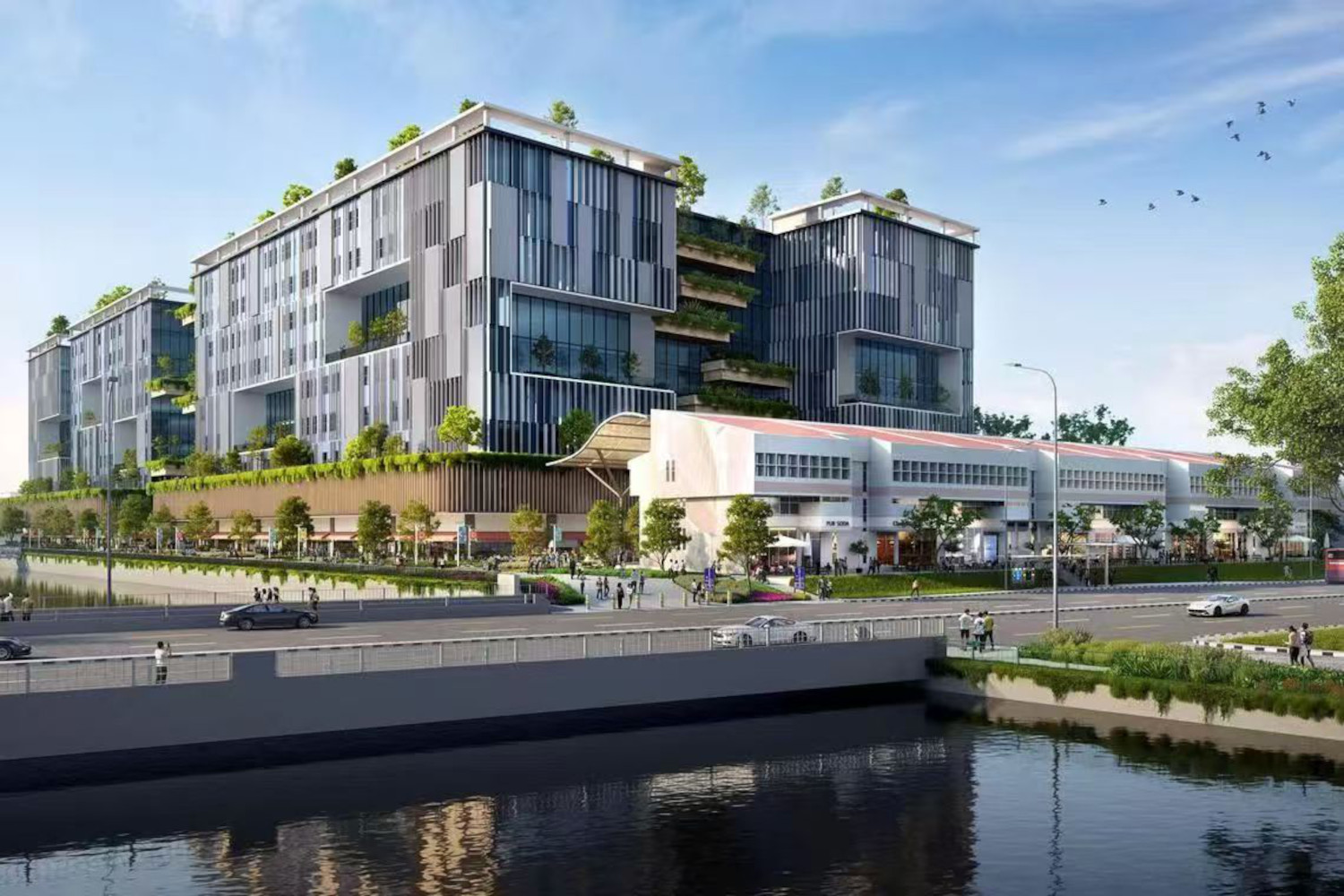
Located at Kallang Way, in the established industrial estate of Kolam Ayer, Gourmet Xchange is an iconic nine-storey building that reinvents the traditional food factory. It is a direct answer to the challenges of operation that have historically burdened Singapore’s food industry: high running costs associated with land scarcity, and the technical constraints of older industrial building typologies.
In creating a tailor-made space, CLD isn’t just providing square footage; it is providing a future-proofed operating environment that has been designed to meet the incredibly strict demands of 21st-century food production – from traditional central kitchens and caterers through to emerging players in food technology. This is one of the tangible actions that reflects the national movement leveraging on our local production and availability to position Singapore as a global-Asia hub for food, lifestyle and nutrition products.
Tradition Meets High-Tech: The Architectural Statement
What makes Gourmet Echange different in an ordinary industrial park scheme is the artful and considered marination of architectural heritage with ultra-modern contemporary design. As a testament to sustainable development and consideration for history, the design-winning tender proposal by CLD also pledged to preserve and reutilise the last remaining 3-storey terrace-showroom factory cluster on site which was built in the 1980s. The block also will contain a preserved portion of the blockfront and first-floor space in the new building that may be used for retail, F&B and entertainment offerings.
Its mixed-use atmosphere distinguishes Gourmet Xchange as the antithesis of a standard barren industrial park. It becomes a thriving ecosystem which serves the tenants as it provides its workers with amenities, and in tandem also serves the surrounding residential catchments of Paya Lebar and Macpherson. This blending of community and commerce creates a sense of place and lures a more diverse, skilled labour force — a boon for an industry that frequently struggles to fill jobs. This kind of architectural turn is what land-constrained cities can learn from, in order to generate high-intensity industrial use and improve upon the quality of built environment while protecting history.
And it is the new nine storey block where the real industrial design surprises occur. Aware that logistics and internal traffic play a role in higher production costs, the plant provides full “ramp-up” access to all floors. It’s this extremely important design feature that means a 40-foot container truck can park up right outside the front door of your unit, whether you are situated on the top floor or at ground level. This eliminates the need to lean on flour truck elevators, and with drastically reduced waiting times, the pace at which raw ingredients arrive and finished products depart will be maximized for ultimate throughput. The very good design makes the often weakest link of mass production, the logistic chain, robust and efficient and yields into less costs and shorter cycle-times for tenants.
A Food Innovation Engine: Excellence in Operations
In the case of food processors, the value of a space is dictated by its operationally flexibility and conformity. Gourmet Xchange is designed to remove the tradeoffs you often make when attempting to retrofit general industrial for specialized food production. The building, which has modularity in mind and is easily expandable, offers huge flexible floor plates ideal for space from about 3,000 up to 7,000 square feet. And most importantly, its base capabilities are built to be robust and cuts above:
- High floor loading: Capable of heavy processing machinery and high density storage systems.
- High Ceiling Experience: Generous floor-to-floor heights of as tall as 6.65m allows the installation of a system a process column, large-sized ovens, blast freezers and complex ventilation to facilitate automation utilizing high space vertically.
- Dedicated Utilities: Each unit has ample electrical power, dedications of kitchen exhaust shafts, grease traps and drainage.
These benefits enable tenants to comply with the strict standards set by regulatory authorities like the Singapore Food Agency (SFA) effortlessly. The equipment is HACCP-permissive upon installation (Hazard Analysis and Critical Control Points), with details including separate entry points and paths for raw materials and end products to avoid cross- contamination. Through the provision of this ultra-specialised, “plug-and-play” environment Gourmet Xchange dramatically lowers the tenant’s capex on fit-out, and cuts down time to open for business considerably.
It is useful particularly for the food-tech and alternative proteins space, a key thrust of Singapore’s SFS 2.0 mission. Growing cultivated meat or precision fermentation at scale involve tightly controlled environments, specialized bioreactors and clean-room capabilities. Infrastructure to scale and grow Gourmet XChange provides the infrastructure (utilities, dedicated ventilation, volume of ceiling height) to enable these companies to go from pilot scale up through commercial-scale production– without ooding them with the costs and headaches of modifying a standard building. The institutionalization is the venerable springboard between scientific discovery and marketplace reality.
The Central Connection: A Strategic Advantage
In high-stakes Singapore industry, a prime spot is about more than prestige. it gives them an important logistical and talent edge. Strategically located, Kallang Way has excellent transportation network that fulfils a key requirement for the food hub. Being strategically located near major expressways such as the PIE and KPE, allows time-sensitive food products rapid distribution channels around the island.
Just as crucial is the availability of public transport. Being within reach of 4 MRT stations (Aljunied, Geylang Bahru, Macpherson and Mattar), Gourmet Xchange. This level of connectivity is especially critical to the mobile workforce. The food processing industry, particularly niche high-tech markets, has a dependence upon its more technical and skilled labor force. Its accessibility makes it easier for tenants to lure talent and retain that talent in what continues to be an extremely competitive job market, which just so happens to also indirectly support productivity gains via a reliable and well-supported labour force.
The density of sympathetic food and drink businesses in one cutting-edge space creates an invaluable eco-system of synergy. Tenants not only take advantage of shared facilities, they are close to potential partners, suppliers and markets. This environment is good for the sharing of best practices, solving problems together and, potentially, shared logistics or sourcing that can cut costs and accelerate innovation among cluster companies. It also makes the Kallang Way estate a well-established food manufacturing hub, with such companies based there.
Future-Proofing Singapore’s Food Resilience
Gourmet Xchange by CapitaLand Development is a case in point showing how private sector investments could be carefully calibrated to the nation’s economic and security objectives. It is a strong vote of confidence in Singapore’s commitment for a sustainable and high-value food manufacturing industry. Shifting from a “30 by 30” aspirational goal to specific fibre and protein goals by 2035 requires highly productive, resource-efficient farming systems and production methods. These approaches, from high-tech vertical farming to advanced aquaculture and beyond, all have one thing in common: They need ultra-sophisticated, highly specialized real estate.
In addressing the fundamental challenges of how various space is used, innovatively engaged racking and compliance concerns with intelligent custom design, Gourmet Xchange is actually derisking the local food production expansion. It is the physical manifestation of what will be a new generation of local champions and global food innovators who are reared on Singaporean shores.
It’s a place that offers proof positive that industrial design can be used to fast-track ourselves to food sovereignty, re-establishing high density, high efficiency and abundant quality in perfect harmony.And in so doing it saves the nation’s plate for generations. Gourmet Xchange is more than a commercial development; it speaks to an essential aspect of Singapore’s food future, that industrial design can sustainably meet the pressing needs of creativity and national security.


